logo
Dobra cena  w Internecie

szczegółowe informacje o produktach

Created with Pixso. Dom Created with Pixso. Produkty Created with Pixso.
Maszyna do robienia tostów
Created with Pixso. Multi-Layer Danish Loaf Bread Processing Line | Commercial Flaky Cube Toast Plant

Multi-Layer Danish Loaf Bread Processing Line | Commercial Flaky Cube Toast Plant

Nazwa marki: Zline (Industrial Dough Solution)
Numer modelu: Dostosowane (w oparciu o pojemność)
MOQ: 1 zestaw (test produkcji pomocniczej)
Cena: Get Latest Project Quote
Czas dostawy: Zaplanowane według skali projektu (30-45 dni)
Warunki płatności: T/T, akredytywa
Informacje szczegółowe
Miejsce pochodzenia:
Chiny
Orzecznictwo:
CE
Typ linii produkcyjnej:
Przemysłowa linia laminowanego chleba w kostkach
Technologia przetwarzania:
Automatyczne zamykanie tłuszczu, beznaprężeniowe foliowanie
Kompatybilne produkty:
Tost Mille-feuille, Bochenek duński, Chleb w kostce
Zdolność produkcyjna:
2 000 – 25 000 szt./godz
Szerokość stołu roboczego:
800 mm (modułowy standard przemysłowy)
Zakres masy ciasta:
25g – 1000g
Budownictwo Sanitarne:
Stal nierdzewna SUS304 przeznaczona do kontaktu z żywnością
Sterowanie automatyką:
System z ekranem dotykowym oparty na recepturach PLC
Szczegóły pakowania:
Wzmocniona drewniana skrzynia na ciężki sprzęt przemysłowy
Możliwość Supply:
Dostosowana wydajność dostaw projektu
Opis produktu


ZLINE Industrial Laminated Cube Bread Production Line


Automated Turnkey Solution for Commercial Mille-Feuille Toast & Danish Pastry Loaves

ZLINE automatic pastry laminating and makeup production line for laminated cube bread and mille-feuille toast, featuring 3D CAD design layout of the industrial butter enclosing section and multi-roller sheet reduction systems.


The ZLINE Industrial Laminated Cube Bread Production Line is engineered for the high-capacity, fully automated manufacturing of premium flaky cube toast, Danish block bread, and multi-layer mille-feuille sandwich loaves. Utilizing an advanced, stress-free dough sheeting and fat enclosing method, the ZLINE system preserves the sensitive gluten matrix while creating uniform, multi-layered pastry dough structures. Constructed entirely from food-grade SUS304 stainless steel and regulated via a centralized PLC control system with programmable touch-screen recipe storage, this heavy-duty laminating and make-up plant ensures seamless transition from a raw dough block to precisely segmented, tray-loaded toast embryos ready for commercial baking ovens.


Step-by-Step Processing Stages & Mechanical Layout


1. Stress-Free Dough Band Forming & Transport

The production sequence initiates at the heavy-duty cutting hopper and an inclined elevating conveyor. The raw dough mass is discharged into the dough band forming device, where a sequence of satellite rollers compresses the dough into a continuous, uniform sheet. This stress-free reduction method prevents over-stretching and cellular breakdown of the dough, ensuring consistent elasticity, density, and gas retention across the entire conveyor width.


Smooth and elastic mixed pastry dough block on the ZLINE feeding conveyor, demonstrating a fully developed gluten network prior to the sheeting process.   Industrial fat enclosing system with mechanical folding shoes wrapping the outer edges of the dough band over the extruded butter sheet.


2. Automated Fat Pump & Butter Enclosing 

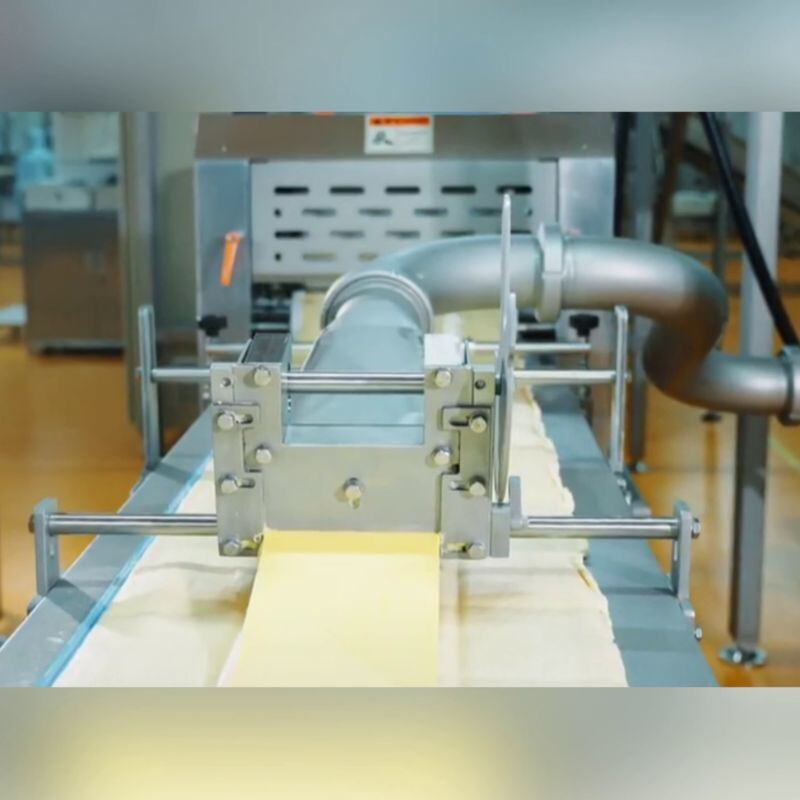
A synchronized, industrial-grade fat pump (butter depositor) extrudes a calibrated, flat layer of pastry fat or butter directly onto the moving dough band. The integrated folding shoes wrap the outer edges of the dough over the fat core, achieving complete, secure fat enclosing (butter enclosing) without leaking edges, guaranteeing an even distribution of fat-to-dough ratios.


Dynamic reciprocating swinging arm folding and stacking the enclosed dough band to create uniform multiple laminated pastry layers. Heavy-duty pneumatic guillotine cutter segmenting the multi-layer laminated pastry dough block into precise sections.


3. Multi-Stage Gauging & Dynamic Folding 

The enclosed dough band moves progressively through a series of multi-roll devices, where it undergoes calibrated thickness reduction. The sheeted band is then directed to the laminating device, utilizing a dynamic reciprocating swinging arm (feeding & folding mechanism) to drop and overlap the dough layers onto the lower belt. This precise mechanical stacking creates the initial multi-layer laminated structure essential for the distinct "tree-ring" inner pattern of mille-feuille toast.


Multi-roller gauging device performing progressive thickness reduction on the laminated dough sheet without tearing fat micro-layers. Rotating disk cutters dividing the dough sheet into parallel strips, separated across a two-tier conveyor system to prevent edge adhesion.


4. Calibrated Multi-Roller Reduction & Flour Dusting

The laminated dough block passes through subsequent multi-roll devices and an integrated double-roll gauging device. To prevent belt adhesion and maintain a pristine surface finish, automated flour dusters distribute a fine, controlled layer of dusting flour onto both the top and bottom surfaces. The dough sheet is incrementally thinned down to the targeted final millimeter specification without tearing or breaking the nested micro-fat layers.


5. Multi-Row Strip Slitting, Filling Injection & Loaf Rolling

On the extensive make-up platform, the broad dough sheet is divided into multiple parallel tracks via rotating disk cutters. For filled varieties, a multi-nozzle filling injector (depositor) deposits sweet or savory creams, chocolate, or pastes. Immediately following, a specialized stainless steel rolling mesh (dough rolling device) catches the moving strips, rolling them into tight, multi-layered cylindrical loaves.


6. Precision Loaf Alignment & Servo Cutting

The rolled cylindrical dough streams pass through vertical dough guiding pillars (aligning device) and a specialized leveling pressure roller. These components align and stabilize the loaves before they enter the high-speed servo cut device. The servo-driven guillotine cutter executes precise, high-speed vertical cuts, segmenting the continuous dough strips into identical, crisp-edged cube toast embryos without squeezing or sealing the delicate laminated cross-section.


Segmented raw flaky Danish cube bread embryos with clean-cut laminated cross sections on the processing belt. Aligned mille-feuille cube toast embryos being transported toward the automated retracting panning conveyor for placement.


7. Automated Retracting Panning & Tray Loading

The segmented cube toast embryos are transferred to a high-speed retracting panning conveyor machine. The retracting nose precisely deposits the raw embryos in a perfectly squared, multi-row matrix directly into waiting toast baking tins or baking trays. This eliminates manual handling, ensures zero product deformation, and preps the batch for immediate final proofing and commercial baking.


Commercial square toast baking tins stabilized on the conveyor mechanism, waiting for automated embryo deposition. Matrix-loaded square toast embryos in trays moving continuously toward the commercial proofing and industrial baking tunnel oven.


Key Engineering Advantages


  • Modular Design for Product Flexibility: The ZLINE make-up platform is highly customizable. By changing the cutting tools and folding accessories, the line easily switches from large-capacity sandwich tin breads to small-bite Danish pastries, croissants, and filled buns.

  • Hygiene and Wash-Down Compliance: Designed for strict industrial food safety regulations, the entire line features a rigid, open-frame stainless steel construction that eliminates food trap corners and allows for fast, efficient wet cleaning.

  • Recipe-Driven Automation: The centralized PLC system memorizes operating speeds, roller gaps, and cutting frequencies for various products, enabling rapid product changeovers and reducing downtime between production shifts.